The Finding of Medusa


Perseus sought out Medusa's lair, surrounded as it was by the petrified remains of previous visitors, and he found the Gorgon sleeping.


The Calling of Perseus


At the beginning of his quest for the head of Medusa, Perseus receives help from the goddess Athena, although at first he spurns her words of advice. She gives him a sword and a mirror to protect him from the Gorgon, whose glance turns men to stone. He next proceeds to the three Graiae, who collectively share a single tooth and a single eye, which Perseus snatches from them in order to gain information about where he can find the sea nymphs. After he discovers the cave of the nymphs, they bestow on him the winged sandals of Hermes, the helmet of invisibility and a bag in which to carry Medusa's head.

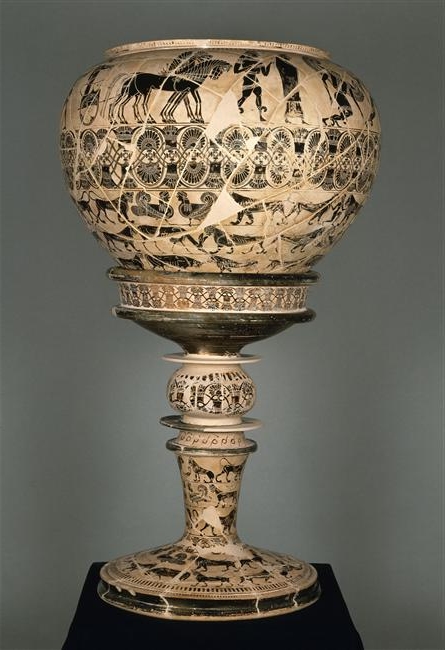
Perseus pursued by Gorgons by "The Gorgon Painter" 580 BC


The handsome bowl atop this fancy stand in the Louvre (F874) is a dinos, a punch bowl that was filled with wine mixed with water and set out to serve the guests at a banquet or dinner party and into which they could dip their wine cups. We wonder, however, whether this one was ever put to such a use, its stand being so elaborate as to suggest it was created mainly as an ostentatious showpiece. It was made in Athens about 580 BC and painted by a painter who didn't sign it but is known today as "The Gorgon Painter," after this famous vase.

Most of the vase and its stand are painted in a series of bands or "friezes" with abstract geometric designs or rows of animals in the older "Geometric" and "Corintian" styles. Only the top band or frieze is given over to story-telling involving mythic heroes and their gods. The hero here is Perseus, who, backed by Athena and Hermes, set out to behead the mortal Gorgon Medusa and bring her head back to Athena. On the vase we see Hermes and Athena standing by to protect Perseus right after he beheaded Medusa and now flees from her two immortal sister Gorgons.


Hermes and Athena abet the murder of Medusa, who falls headless, as her sister Gorgons chase after Perseus. The Louvre notes that "In place of her severed head, the painter has drawn a series of hatched strokes." I think he meant them as spurting streams of blood. Note, below the geometric palm frieze in the band below them, in the same "kneeling/running" pose as the three Gorgons, the Mistress of the Beasts between a lion and a lioness.


Medusa's two sister Gorgons chasing Perseus. Like Medusa, all three figures here wear winged ankle-boots, signs of speed as well as flight, and all four of them are drawn in the "kneeling-running" pose that prevailed in the Archaic period. Also, unlike Perseus, all three Gorgons have Archaic wings curved like scythes, and they are twisted from the waist up to face and frighten the viewer and ward off evils or whatever. 


Reposted from Ancient Worlds

Perseus Pursuing Medusa

Perseus, wearing the winged cap and boots of Hermes, chases after the Gorgon Medousa with sword drawn. The Gorgon is depicted as a winged woman with talonned hands, a broad round face, wide mouth, protruding tongue and staring eyes.


More Perseus and the Hesperides

The Arming of Perseus - Edward Burne-Jones

The Arming of Perseus -  Edward Burne-Jones 

Athena instructed Perseus to find the Hesperides, who were entrusted with weapons needed to defeat the Gorgon. Following Athena's guidance, Perseus sought out the Graeae, sisters of the Gorgons, to demand the whereabouts of the Hesperides, the nymphs tending Hera's orchard. The Graeae were three perpetually old women, who had to share a single eye. As the women passed the eye from one to another, Perseus snatched it from them, holding it for ransom in return for the location of the nymphs. When the sisters led him to the Hesperides, he returned what he had taken.

Athena wearing her aegis, with its snake-fringe and gorgon head Toledo 1963.26, Attic black figure calyx krater, c. 520-515 B.C. 


From the Hesperides he received a knapsack (kibisis) to safely contain Medusa's head. Zeus gave him an adamantine sword and Hades' helm of darkness to hide. Hermes lent Perseus winged sandals to fly, while Athena gave him a polished shield. Perseus then proceeded to the Gorgons' cave. 

Perseus and the Hesperides

 THE HESPERIDES were the goddesses of the evening and golden light of sunset. The three nymphs were daughters of either Nyx (Night) or the heaven-bearing Titan Atlas. They were entrusted with the care of the tree of the golden apples which was first presented to the goddess Hera by Gaia (Earth) on her wedding day. They were assisted in their task by a hundred-headed guardian drakon named Ladon. Herakles was sent to fetch the apples as one of his twelve labours, and upon slaying the serpent, stole the precious fruit. However, Athena later returned them to the Hesperides.

The Hesperides were also the keepers of other treasures of the god. Perseus obtained from the artifacts he required to slay the Gorgon Medusa.

The three nymphs and their golden apples were apparently regarded as the source of the golden light of sunset, a phenomena celebrating the bridal of the heavenly gods Zeus and Hera.


Detail of the three Hesperides, the tree of the Golden Apples and the coiling Drakon - British Museum, London, UK

Perseus and the Graiae

At the beginning of his quest for the head of Medusa, Perseus receives help from the goddess Athena, although at first he spurns her words of advice. She gives him a sword and a mirror to protect him from the Gorgon, whose glance turns men to stone. He next proceeds to the three Graiae, who collectively share a single tooth and a single eye, which Perseus snatches from them in order to gain information about where he can find the sea nymphs. 

After he discovers the cave of the nymphs, they bestow on him the winged sandals of Hermes, the helmet of invisibility and a bag in which to carry Medusa's head.

Edward Burne-Jones - Perseus and the Graiae


The Gorgon Sisters' Sisters

The Graeae were two, or some say three, ancient sea-daimones (spirits) who personified the white foam of the sea. They were grey from birth, and shared among themselves a single detatchable eye and tooth.

Perseus & Graea, Athenian red-figure krater
C5th B.C., Archaeological Museum of Delos


The graeae guarded the passage that led to where their sisters were. When Perseus was searching for Medusa, he stole their one eye and one tooth which they shared, forcing them to help him find and kill Medusa. 

Their names suggest rather dire monsters--Deino "the terrible." Enyo "the warlike" and Persis "the destoyer."

The Graiai were usually depicted as old crones. However according to Aeschylus they were Seiren-shaped monsters with the head and arms of old women and the bodies of swans.

Perseus Returning the Eye of the Graiai, Henry Fuseli.


Euryale

Euryale was the second eldest one of the Gorgons, three vicious sisters with brass hands, sharp fangs, and hair of living, venomous snakes.

Euryale's name is translated to mean "far-roaming." She was known for her bellowing cries. Her cries were projected from her due to her mourning for her sister. It is said that Athena invented the flute to try and copy the cries of Euryale.

She and her sister Stheno, were immortal, where as Medusa was mortal. In some versions of mythology, Euryale also had the ability to turn anyone to stone with her gaze. They were daughters of primordial sea god and goddess Phorcys and Ceto, who personified the dangers of the sea. In many stories, Euryale is noted for her bellowing cries, particularly in the tale of Medusa's death at Perseus' hands.


Museum of Nabeul Athena tossing away the flutes she had just invented. She did so after she realized (by seeing her image in a river) that playing them disfigured her face (from Kelibia)


Stheno

Stheno in Greek mythology, was the eldest of the Gorgons, vicious female monsters with brass hands, sharp fangs and "hair" made of living venomous snakes. Her name can be translated as “forceful” or “mighty.” She and her sister Euryale were both immortal, and the third sister, Medusa, was mortal until she was immortalized in her hideousness by Athena.

Of the three Gorgons, she was known to be the most independent and ferocious, having killed more men than both of her sisters combined. In Greek mythology, she was transformed into a Gorgon because of standing with her sister Medusa, who was raped by the sea god Poseidon in the Temple of Athena.


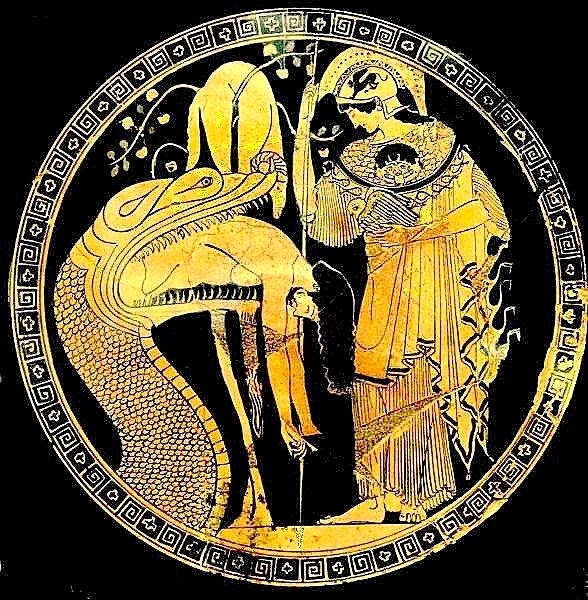
Athena wears the ancient form of the Gorgon head on her aegis, as the huge serpent who guards the golden fleece regurgitates Jason; cup by Douris, Classical Greece, early fifth century BC – Vatican Museum